seoPublished on July 22, 20266 min read

DAM Solved the Library Problem. Content Activation Is the Next Challenge

Companies with well-implemented DAM systems still face campaign delays and manual rework. Discover why digital asset management doesn't solve the content activation problem.

DAMDigital Asset ManagementAutomação de MarketingRPATransformação DigitalMarketing DigitalGestão de ConteúdoIntegração de Sistemas
DAM Solved the Library Problem. Content Activation Is the Next Challenge
Bitclever AI Research
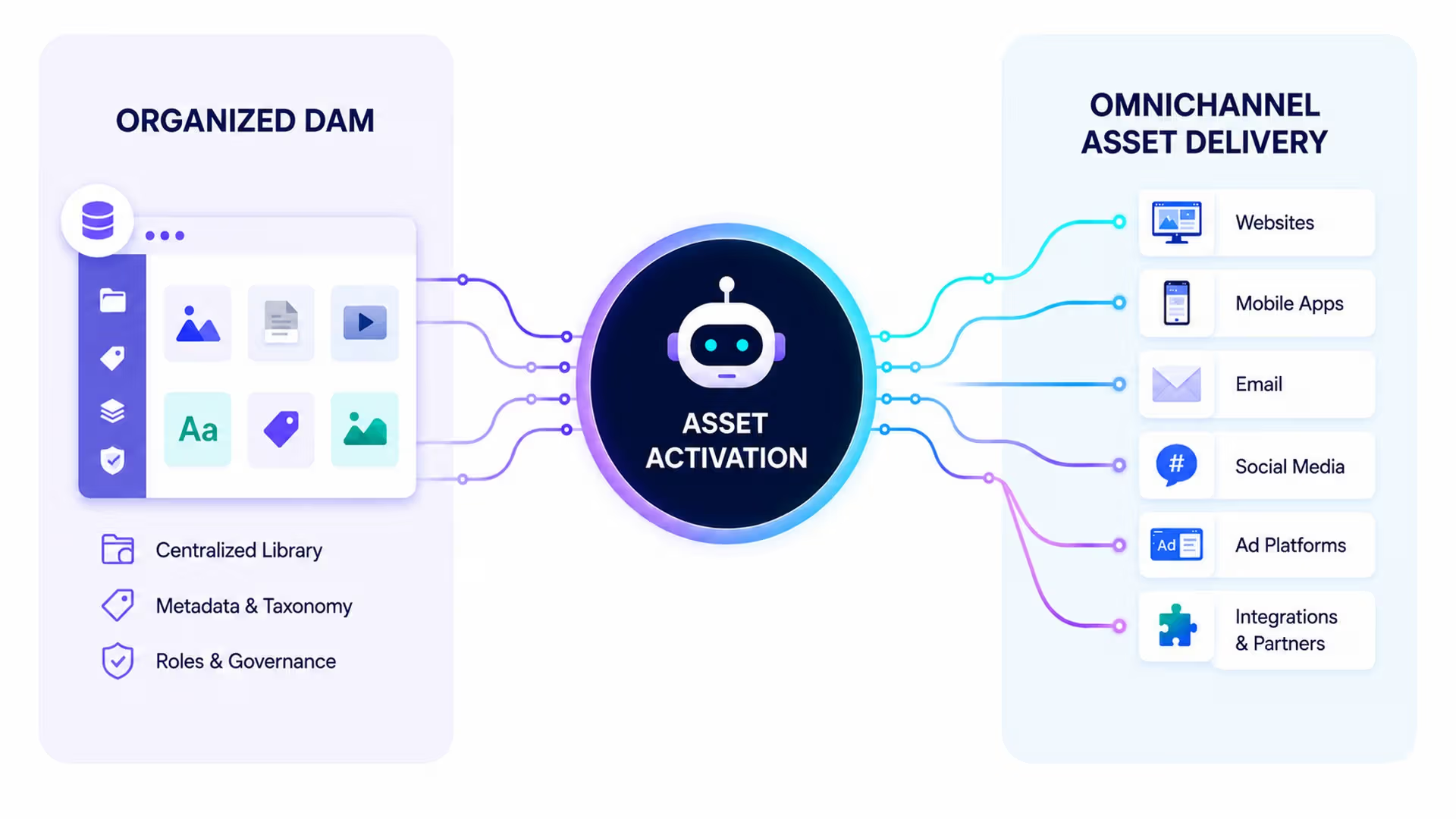
Author: Bitclever AI Research ## Executive Summary Many organisations have invested in Digital Asset Management (DAM) solutions to centralise and organise their digital assets, and this organisational layer is, indeed, working. However, a recent article by ImageKit published on Search Engine Land reveals a critical gap: having a well-structured asset library does not mean those assets are ready to be activated across different campaigns, channels and markets. This article examines the distinction between "organising" and "activating" digital content, and what this means for businesses that depend on agile, scalable marketing operations. ## What Happened According to the article published by ImageKit on Search Engine Land, many companies that have implemented DAM systems consider the project a technical success: assets are centralised, metadata is correctly applied, and clear permission and governance rules are in place. All the traditional indicators of a successful DAM implementation are present. Even so, the article points to a persistent problem: campaigns continue to be delayed, engineering teams continue to receive manual requests to resize hero images, and regional teams — the example given is a team in the APAC region — end up manually re-uploading files into their local content management systems, because they cannot pull assets directly from the DAM efficiently. The article's central conclusion is clear: the DAM is not broken. The problem lies in the assumption that a functional DAM equates to content that is ready to use. As the article summarises, "a library and a supply chain are not the same thing." The original promise of DAM was organisation — a single location for assets, consistent metadata, and governance over which versions are approved and up to date. This is essentially a library problem, and modern DAMs solve it well: assets are searchable, versions are controlled, and expired content is not accidentally published. However, activation is a distinct supply chain problem. An asset must reach a campaign page, a product page, a social media post, an email — and each of these destinations requires the correct format, dimensions and technical specifications, adapted to the specific channel and market. ## Why This Matters This distinction between "organising" and "activating" content is particularly relevant in the current context of omnichannel digital marketing, where brands need to distribute the same visual assets across dozens of formats, platforms and geographic markets simultaneously. The issue becomes even more relevant when we consider how much campaign cycles have compressed in recent years. It is no longer enough to have a well-organised central repository — marketing and technical teams need automated workflows that transform and distribute assets without constant manual intervention. The problem identified in the article reflects a broader trend in digital transformation: the difference between implementing a tool and implementing a process. Many organisations invest significant time and budget in acquiring and configuring technology platforms, but neglect the automation and integration layer that actually delivers operational value. A DAM without automated activation capabilities becomes, in practice, a passive repository that still requires intensive manual work downstream. This scenario has direct parallels with other areas of business automation: having centralised data in a database does not mean business processes are optimised; having digitised documents does not mean approval workflows are automated. Organisation is the foundation, not the end goal. ## Business Impact For organisations that depend on large-scale marketing and digital content operations, this gap between organisation and activation translates into concrete operational costs: **Campaign delays** — When assets need to be manually resized, reformatted or reprocessed before they can be published on each channel, campaign launch times increase significantly, jeopardising commercial and seasonal deadlines. **Overload on technical teams** — Recurring requests for repetitive tasks, such as image resizing or format conversion, consume valuable engineering team time that could be focused on higher-value strategic initiatives. **Duplication of effort and brand inconsistency** — When regional or local teams cannot efficiently pull assets directly from the central DAM, they resort to manual re-uploads into local systems, creating content silos, outdated versions and risks of brand inconsistency across markets. **Limited scalability** — As the number of channels, formats and markets increases, reliance on manual asset adaptation processes becomes a bottleneck that prevents sustainable growth of digital marketing operations. For Portuguese and European companies operating across multiple markets and languages, this problem is even more pronounced, given the volume of localised adaptations required for each campaign. ## Bitclever Perspective At Bitclever, we closely follow the challenges companies face in moving from a "digitisation" approach to a "real automation" approach to their business processes — and the problem described in this article is a clear example of this incomplete transition. Our experience in Robotic Process Automation (RPA) and Low-Code development projects, namely with platforms such as OutSystems and Appian, consistently shows us that the biggest operational wins do not come from acquiring new tools, but from building integration and automation layers that connect existing systems — such as a DAM — to the real workflows of marketing, communications and sales teams. A structured approach to solving the "activation problem" typically involves three complementary fronts: 1. **Asset transformation automation** — implementation of automated workflows that generate, from a central asset, all the format, dimension and resolution variants needed for each channel, without manual intervention. 2. **System integration** — building connectors and APIs that allow local systems (regional CMS platforms, social media platforms, email marketing tools) to access the central DAM directly, eliminating the need for manual re-uploads. 3. **Intelligent governance through automation** — applying automated business rules that ensure only approved and up-to-date asset versions are distributed, maintaining brand consistency without adding friction to the process. We believe that the right technology, well implemented and integrated into teams' real processes, is what truly transforms a DAM investment from a maintenance cost into a business accelerator. Our role is to help companies identify exactly where these invisible bottlenecks between organisation and activation lie, and to design tailored automation solutions that solve the problem at its source, not just the symptoms. ## Conclusion The ImageKit article brings to light an uncomfortable truth for many organisations: having a well-implemented DAM is only the first step of a longer journey. True operational efficiency only materialises when digital assets flow automatically from the central library to the final point of consumption — whether a campaign, a product page or a social media post — without constant manual intervention. For companies that recognise this pattern in their own operations, the path forward involves critically assessing where activation bottlenecks reside and investing in automation and integration that transform organised repositories into truly agile, scalable content supply chains. This is increasingly an essential condition for competing effectively in a digital market where execution speed is a direct competitive differentiator. --- *Source: [Search Engine Land - ImageKit](https://searchengineland.com/your-dam-solved-the-library-problem-the-activation-problem-is-next-482033)*