seoPublished on July 25, 20264 min read

Google Ads Editor 2.13: AI Max Support Arrives for Shopping Campaigns

The new version of Google Ads Editor brings AI Max to Shopping, retention goals in Performance Max, and updates to Demand Gen. Find out what changes for PPC managers.

Google AdsAI MaxPPCMarketing DigitalPerformance MaxDemand GenSEOPublicidade Digital
Google Ads Editor 2.13: AI Max Support Arrives for Shopping Campaigns
Bitclever AI Research
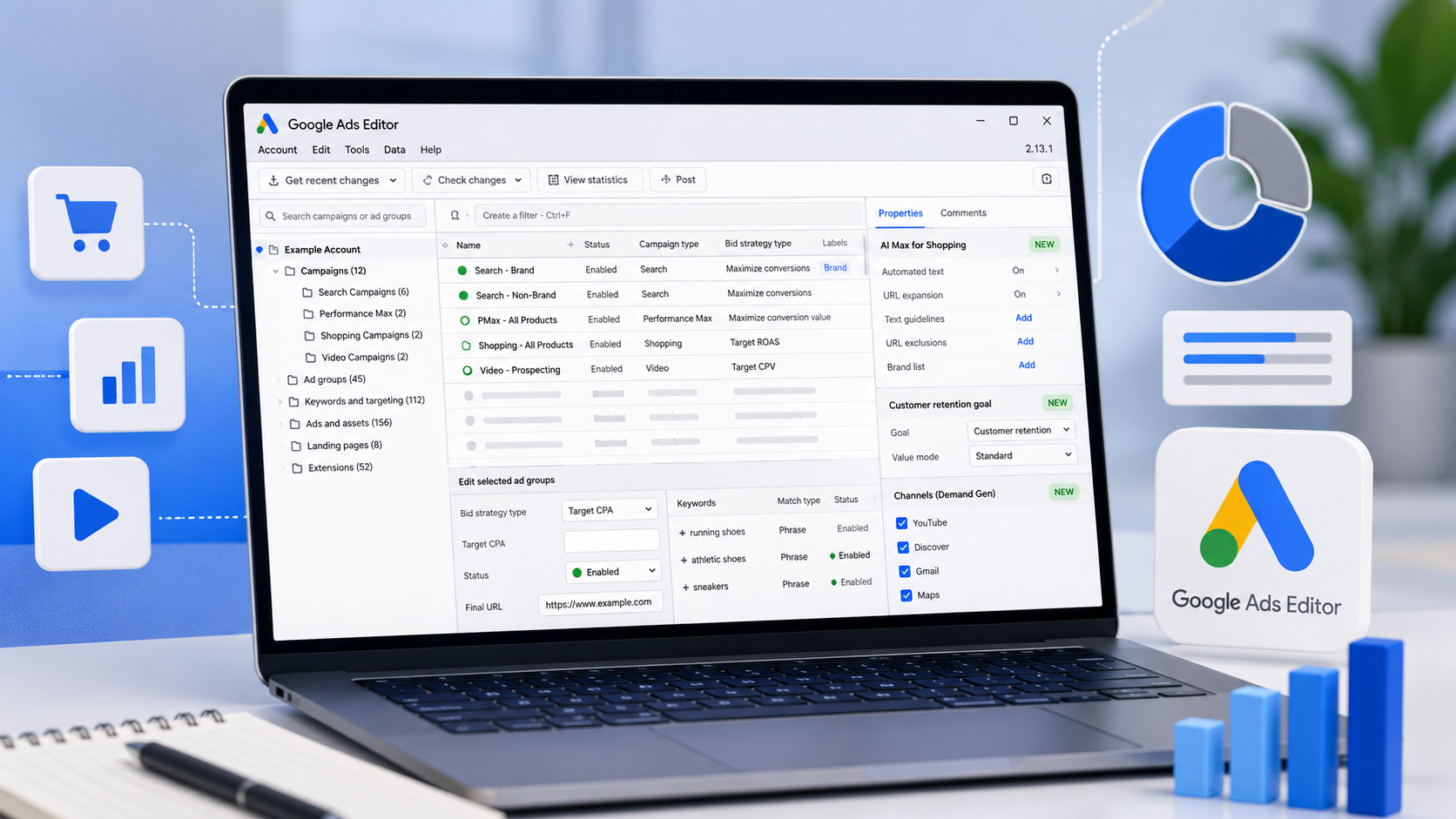
Author: Bitclever AI Research ## Executive Summary Google has released version 2.13 of Google Ads Editor, introducing full AI Max support for Shopping campaigns, new customer retention goals in Performance Max, and significant improvements to Demand Gen. The update brings the offline management tool closer to the capabilities already available in the Google Ads web interface, consolidating the integration of artificial intelligence across the entire campaign ecosystem. ## What Happened According to Search Engine Land, Google Ads Editor 2.13 is now available and brings a broad set of updates focused on aligning the offline management tool with the latest AI-powered features in Google Ads. Key additions include: - **Full AI Max support in Shopping campaigns**, including automatic text generation, URL expansion controls, brand lists, and URL exclusions; - **Customer Retention Goals** in Performance Max campaigns, enabling optimization for re-engaging existing customers; - **New Company Name and Logo fields** for responsive and non-skippable video ads; - **Maps placement support** for Demand Gen campaigns; - **Native Channel Performance reporting**, bringing the Editor closer to the Google Ads web interface; - **AI-generated content disclosure controls**, through a new User Attestation field for images and videos. The update also includes new best-practice alerts for video campaigns, improved column management, support for resuming interrupted downloads, and updates to bid strategy management. On the other hand, Google has removed support for creating new Video Action campaigns in this version. ## Why This Matters AI Max for Shopping is the most relevant addition in this update for PPC professionals, ensuring feature parity between Shopping, Search, and Performance Max campaigns directly within Google Ads Editor. Until now, many advertisers relying on the Editor for bulk campaign management were forced to switch to the web interface whenever they needed to configure advanced AI features — a process that disrupted workflows and reduced operational efficiency. This update confirms a clear trend: Google is progressively expanding AI capabilities across its entire advertising ecosystem, and Ads Editor is no longer just a simple bulk-editing tool but is becoming an AI-driven campaign management platform, nearly on par with the main interface. ## Business Impact For digital marketing teams and agencies managing multiple Google Ads accounts and campaigns, this update carries relevant practical implications: - **Greater operational efficiency**: teams working offline or in an agency context can now configure AI Max, retention goals, and Demand Gen features without relying exclusively on the web interface, speeding up bulk editing processes. - **Need for skills updates**: PPC campaign managers need to understand the new AI Max variables (URL expansion, brand lists, exclusions) to genuinely benefit from automation without losing control over the brand. - **Compliance and transparency**: the new AI-generated content attestation controls are particularly relevant amid growing regulatory scrutiny around the transparency of synthetic content, requiring businesses to adapt their ad asset creation processes. - **Video Action discontinuation**: businesses still using this format should plan migration to supported alternatives, such as Demand Gen or Performance Max campaigns, before support is fully phased out. - **More robust reporting**: the new Channel Performance feature enables more comprehensive analysis directly within the Editor, reducing the need to export data to external tools. ## Bitclever Perspective At Bitclever, we closely follow the evolution of AI-driven digital advertising platforms, and this Google Ads Editor update reinforces a trend we've already identified among our clients: intelligent automation is becoming the new operational standard, not an optional extra. For Portuguese businesses managing Google Ads campaigns — whether SMEs or large accounts managed by an agency — we recommend a careful audit of AI Max settings before mass adoption, ensuring that automatic URL expansion and AI-generated text are aligned with brand guidelines and conversion goals. Bitclever's experience in marketing process automation and low-code tool integration allows us to help organizations structure workflows that combine the efficiency of AI with the human oversight needed to protect brand reputation. Additionally, the introduction of transparency controls for AI-generated content signals that regulatory compliance around generative AI will continue to grow. Companies that start documenting and systematizing these processes early will have a competitive advantage when new regulatory requirements — national or European — become mandatory. ## Conclusion Google Ads Editor 2.13 confirms that advertising campaign management is becoming increasingly dependent on integrated AI capabilities, requiring digital marketing teams to continuously update their knowledge and processes. Companies that manage to balance automation with strategic oversight will be better positioned to capture value from these new features while maintaining control over brand experience and regulatory compliance.