seoPublished on July 16, 20265 min read

Google AI Mode Cites Itself: What This Means for Your Online Visibility

A new report from Profound reveals that Google AI Mode has increased citations of google.com by 8.4x, prioritising its own business profiles and product panels.

SEOAI SEOGoogle AI ModeMarketing DigitalGoogle Business ProfilePesquisa com IAVisibilidade Online
Google AI Mode Cites Itself: What This Means for Your Online Visibility
Bitclever AI Research
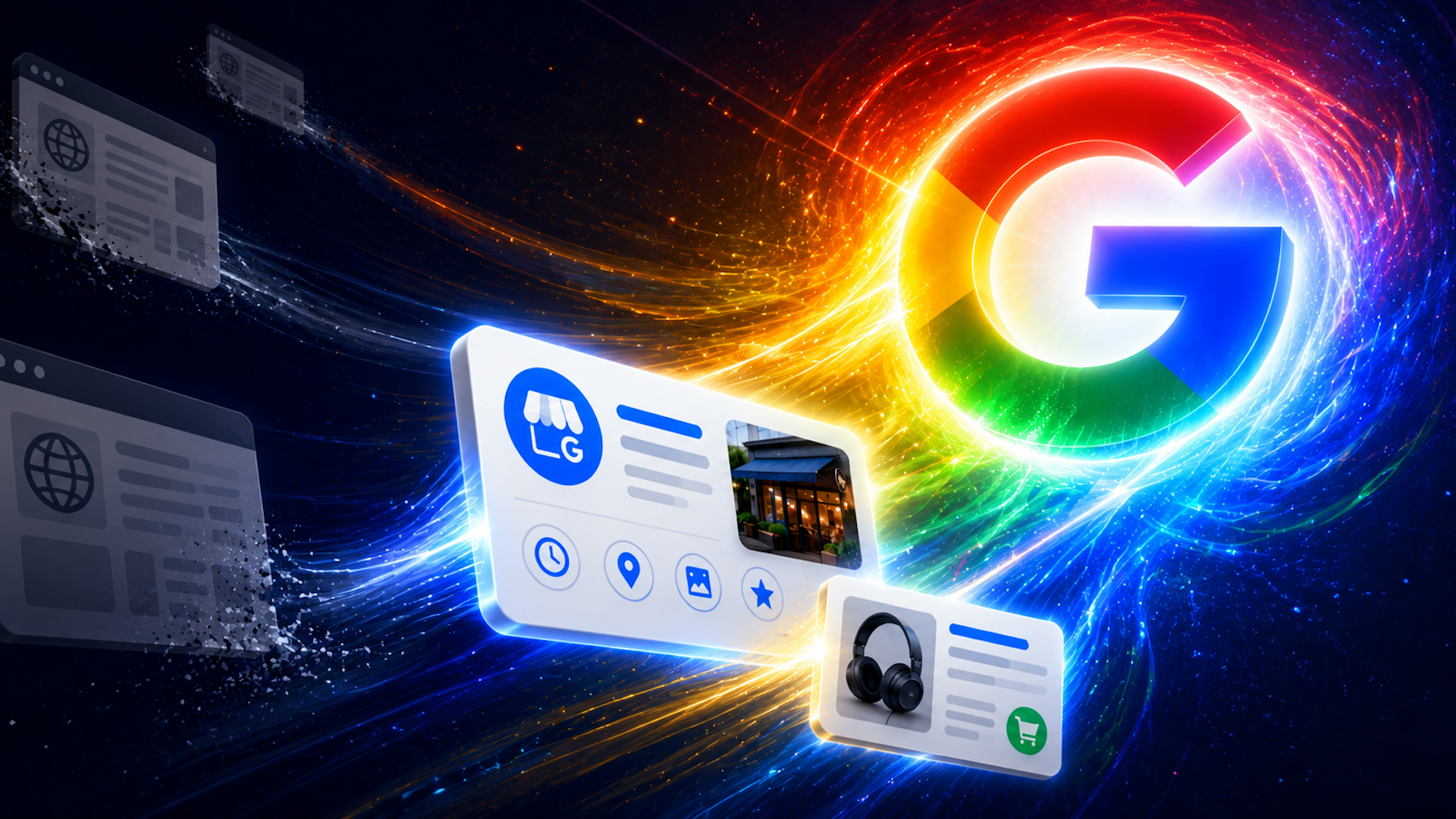
Author: Bitclever AI Research ## Executive Summary A recent report from Profound reveals that Google AI Mode has increased citations of its own domain, google.com, by 8.4 times over a period of approximately two months, making it the second most cited domain in AI-generated answers. This growth is driven mainly by the greater presence of Google Business Profiles and Product Knowledge Panels, which now appear directly in AI Mode responses for local and product searches, frequently taking precedence over the company's own website. ## What Happened According to data from Profound, which analysed more than 32 million instances of google.com/searchviewer between 15 April and 30 June, Google AI Mode began citing itself with significantly greater frequency. This increase did not stem from editorial content created by Google, but rather from the integration of elements that already existed within the search ecosystem: Google Business Profiles and Product Knowledge Panels. In practice, when a user performs a search with local intent — for example, about a restaurant, a home service, or a hotel — AI Mode now presents an inline panel with information such as opening hours, photographs, location, and reviews, pulled directly from the company's Google Business Profile. This panel appears before any hyperlink to the company's official website, effectively becoming the first "page" the user sees. The same phenomenon is replicated in product searches. Queries related to comparisons, compatibility, or technical specifications are increasingly being answered through Google's Product Knowledge Panels, at the expense of direct links to e-commerce sites or brand pages. According to Profound, the sectors where this effect is most pronounced include hospitality and travel, home services, dining, real estate, and healthcare — areas where local search intent has a direct impact on revenue. ## Why This Matters This development represents a significant shift in how Google positions its own assets within AI-generated responses. By favouring its own panels (Business Profiles and Knowledge Panels) over external links, Google is effectively reducing the need for users to visit a company's website to obtain basic information — something that traditionally generated direct traffic. This move is part of a broader trend within the generative AI search engine ecosystem: the line between "search" and "direct answer" is blurring. Whereas SEO previously focused on ranking a website among the top results, it is now also necessary to ensure that information hosted on Google's own platforms — which serve as raw material for these AI responses — is complete, up to date, and optimised. For digital marketing and SEO professionals, this report confirms that the concept of "visibility" is expanding beyond the traditional website, requiring renewed attention to profiles and panels that, until recently, were seen as secondary elements of digital strategy. ## Business Impact The practical implications for businesses, especially those with a strong local or product retail component, are direct and immediate: **Google Business Profiles become critical assets.** Outdated information, incorrect hours, low-quality photographs, or a lack of responses to reviews can cost customers before they even reach the company's website. Active, ongoing management of these profiles is no longer optional. **Potential loss of direct traffic.** If a user obtains the information they are looking for directly within the AI Mode panel, the likelihood of clicking through to the company's website decreases. This can impact traditional organic traffic metrics and requires a reassessment of how the success of SEO strategies is measured. **Product sectors under greater pressure.** Brands and retailers that rely on comparison searches and technical specifications may see their direct visibility reduced in favour of Google's Product Knowledge Panels, making it essential to ensure that product data submitted to Google Merchant Center and associated platforms is accurate and complete. **Need for a multichannel strategy.** Businesses can no longer rely exclusively on website optimisation. Investment is now required simultaneously in traditional SEO, Google profile management, structured product data, and monitoring of how the brand is represented within AI responses. ## Bitclever Perspective At Bitclever, we closely monitor the evolution of generative AI search engines and their impact on our clients' digital marketing strategies. This report from Profound confirms a trend we have been tracking: digital visibility is no longer limited to the institutional website, but now extends to a broader ecosystem of data that feeds automated responses. We recommend that businesses carry out a comprehensive audit of their Google Business Profiles and product data, ensuring that information such as hours, location, photographs, and specifications is always up to date and consistent with the official website. This is a low-cost, high-impact measure that can be implemented quickly. At the same time, through our AI SEO practice, we help organisations understand how their brand is cited — or omitted — in responses generated by tools such as Google AI Mode, ChatGPT, or Perplexity, enabling them to adjust content and digital presence strategies in an informed way, based on real data rather than assumptions. Our role is that of a consultative partner: we help interpret these structural changes in search engine behaviour and translate them into concrete actions, without imposing generic solutions, while respecting each client's reality and level of digital maturity. ## Conclusion Google AI Mode's growing self-citation is a clear sign that the tech giant is reinforcing its control over the search experience, favouring its own assets over external links. For businesses, this means that careful management of Google profiles and product data is no longer a secondary task but a central pillar of digital strategy. Those who adapt quickly to this new reality — ensuring presence, accuracy, and completeness of information across these channels — will be better positioned to maintain visibility and relevance among consumers, in a context where traditional search is progressively being replaced by AI-generated answers.