aiPublished on July 15, 20265 min read

NVIDIA Nemotron: How Open Models Give Businesses Full Control Over AI

NVIDIA is betting on open Nemotron models to enable businesses and nations to build customized, transparent AI under full control, rather than depending on closed models.

IANemotronNVIDIAIA AgentivaModelos AbertosInteligência ArtificialAutomaçãoOpen Source
NVIDIA Nemotron: How Open Models Give Businesses Full Control Over AI
Bitclever AI Research
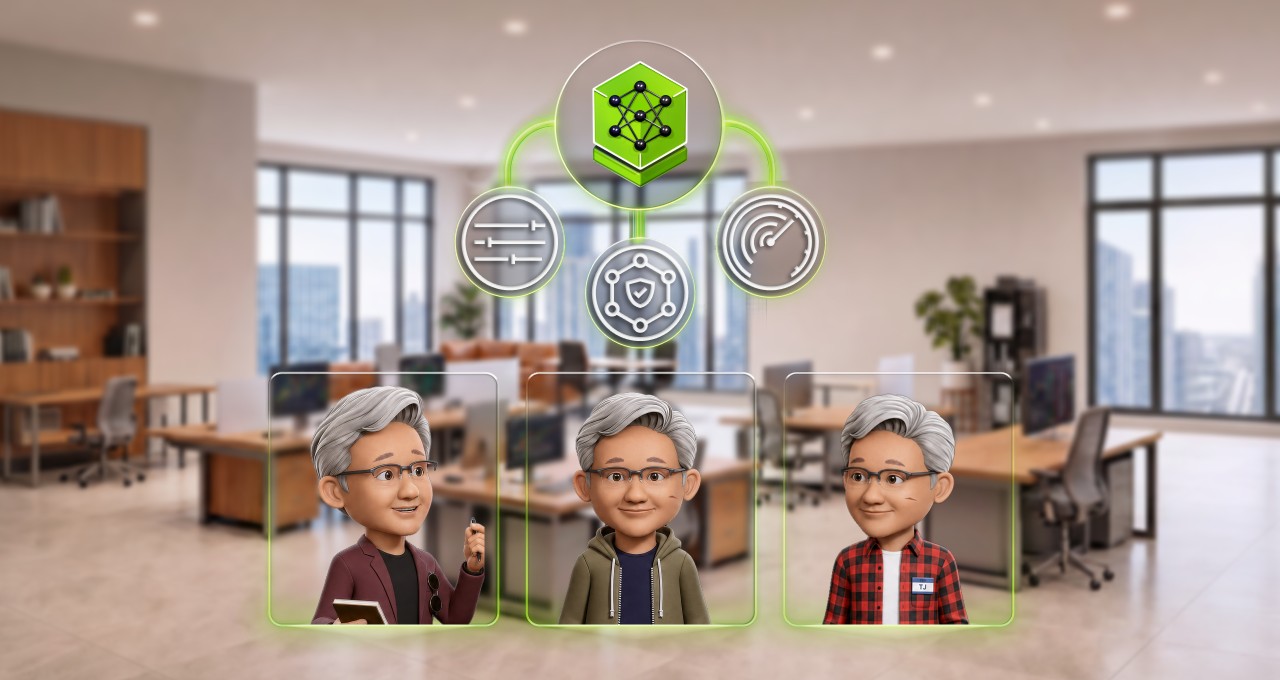
Author: Bitclever AI Research ## Executive Summary NVIDIA has launched a new content series, Nemotron Labs, exploring how open models, datasets and training techniques enable businesses to build specialized AI systems and autonomous agents with full control. The central argument is clear: competitive advantage in AI no longer lies solely in choosing the right model, but in how organizations customize it to meet their specific business needs. ## What Happened NVIDIA published the first article in the Nemotron Labs series, a blog dedicated to practically demonstrating how open models — such as the NVIDIA Nemotron family — can be used to build specialized AI applications in production, on NVIDIA platforms. According to the original source, the goal of this series is to show "practical ways to use an open stack to generate real value in production — from transparent research copilots to scalable AI agents". The introductory article argues that, although numerous powerful AI models are already available on the market, the real test for businesses is whether the AI built uniquely addresses specific business needs: improving workflows, incorporating proprietary domain knowledge, and exceeding the required standards of accuracy and trust. NVIDIA draws a clear distinction between closed models and open models. Closed models continue to push forward the frontier of general intelligence, but they impose a limit on what businesses can inspect, fine-tune and improve. Open models, like Nemotron, remove that barrier, providing full ownership and control over the AI system. One of the central concepts presented is that of "model systems": the most effective agentic AI applications do not rely on a single model, but combine open models with top-tier frontier models, each performing the role it is best suited for. In this architecture, high-performance reasoning models handle complex planning, while specialized open models — fine-tuned with proprietary knowledge and evaluated against real business outcomes — execute well-defined tasks with high precision. ## Why This Matters This positioning by NVIDIA reflects a significant paradigm shift for the tech sector: the discussion is evolving from "which is the best AI model" to "how to build with the models available". This transition has profound implications for any organization seeking to differentiate itself through AI. Exclusive reliance on closed models, managed by third parties through APIs, limits companies' ability to audit model behaviour, adapt it to internal terminology and processes, or ensure strict regulatory compliance. In sectors such as banking, healthcare or public administration, this limitation can be a real obstacle to adopting AI in critical processes. Open models, on the other hand, allow inspection, fine-tuning and continuous improvement to take place within the organization's own control perimeter — or even a nation's, when it comes to technological and data sovereignty. This argument is increasingly present in national AI strategies, where control over infrastructure and models is seen as a matter of security and strategic autonomy. ## Business Impact For IT directors and business decision-makers, this NVIDIA approach translates into several practical implications: - **Real business customization**: instead of adapting processes to the model, companies can adapt the model to their own workflows, proprietary data and specific domain knowledge. - **Trust and transparency**: the ability to inspect the internal workings of the model is essential for regulated sectors, where explainability of automated decisions is an increasing requirement. - **Hybrid agent architectures**: combining specialized open models with frontier models for complex reasoning tasks allows companies to optimize cost, performance and control simultaneously — rather than relying on a single "one-size-fits-all" solution. - **Reduced single-vendor dependency**: by building on open models, companies gain greater strategic flexibility and reduce the risk associated with policy changes, pricing, or availability of third-party closed models. - **Scalability of autonomous agents**: specializing models for well-defined tasks makes it easier to build reliable AI agents that can be evaluated against real business metrics — an essential step for adopting agentic AI in production. ## Bitclever Perspective At Bitclever, we closely follow the evolution of the open AI ecosystem and its practical implications for Portuguese and European businesses. NVIDIA's core message — that competitive advantage lies in how you build with the models available, not just in choosing a specific model — aligns with our consultative approach with clients. We help organizations assess when it makes sense to opt for customizable open models, such as those in the Nemotron family, versus closed frontier models, considering factors such as compliance requirements, need for auditability, operational costs and the complexity of the tasks to be automated. This balance is particularly relevant in process automation (RPA) projects, low-code solutions (OutSystems, Appian) and agentic AI initiatives, where integration between different types of models can determine the success or failure of an implementation. Our experience in technology consulting allows us to support businesses in defining hybrid AI architectures, in model and data governance, and in building specialized agents that respond to real business needs — always with a focus on the trust, control and regulatory compliance required by the markets in which they operate. ## Conclusion NVIDIA's Nemotron Labs initiative reinforces a trend that will become increasingly relevant: competitive differentiation in AI will not come only from choosing the most advanced model, but from organizations' ability to customize, control and trust the artificial intelligence they build. For companies and technology decision-makers, now is the time to reassess AI strategies in light of this logic of ownership and control, ensuring that investments in automation and autonomous agents are aligned with specific business needs — not just with the generic capabilities of a closed model.