aiPublished on July 23, 20265 min read

NVIDIA Powers Up AI Supercomputer at Naval Postgraduate School: What This Means for AI Infrastructure

NVIDIA has brought a DGX GB300 system online at the US Naval Postgraduate School, boosting AI computing power for research in defense, meteorology and cybersecurity.

NVIDIADGX GB300Inteligência ArtificialInfraestrutura de IASetor PúblicoEducaçãoCibersegurançaComputação de Alto Desempenho
NVIDIA Powers Up AI Supercomputer at Naval Postgraduate School: What This Means for AI Infrastructure
Bitclever AI Research
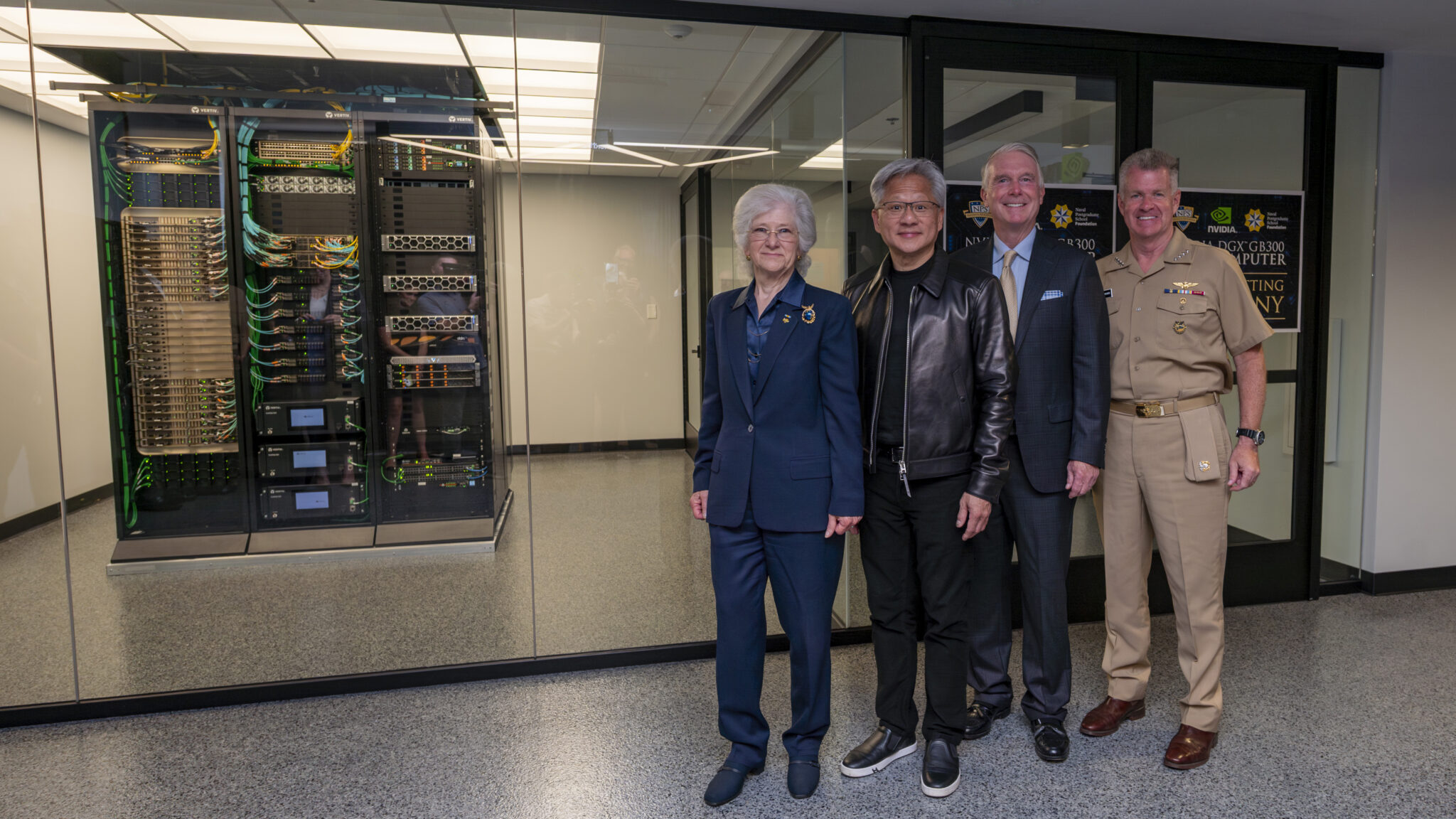
Author: Bitclever AI Research ## Executive Summary NVIDIA has announced that a DGX GB300 supercomputer is now operational at the Naval Postgraduate School (NPS) in Monterey, California, personally commissioned by CEO Jensen Huang. The system, equipped with NVIDIA Mission Control software, delivers large-scale AI training and inference capacity to more than 1,500 students and 600 faculty members, applied to critical areas such as weather forecasting, cybersecurity and disaster response planning. ## What Happened Jensen Huang, founder and CEO of NVIDIA, visited the Naval Postgraduate School during the three-day Converge @ NPS event to officially commission an NVIDIA DGX GB300 system — one of the most powerful AI platforms currently available. The installation was integrated with NVIDIA Mission Control, a software layer designed to manage large-scale AI infrastructure. According to Huang, quoted at the event, "our nation depends on the men and women who fight on the front lines. Nothing is more valuable than information and knowledge, and timely information and knowledge, and understanding its impact and consequence. I can't imagine anything more important." With this on-premises system, NPS now has local computing capacity to train and run large-scale AI models without relying exclusively on external cloud infrastructure. The identified applications include weather forecasting, cybersecurity threat detection and response, and disaster resilience and response planning — domains where latency, data security and information sovereignty are critical factors. This commissioning represents another step in an ongoing collaboration between NVIDIA and NPS to develop AI-based technologies, both for educational purposes and for real operational applications within the context of this premier academic institution for the US armed forces. ## Why This Matters This announcement illustrates a broader trend in the industry: the migration of frontier AI capabilities to on-premises infrastructure in organizations with high requirements for security, data sovereignty and real-time performance. While many companies continue to rely on public cloud AI services, mission-critical organizations — whether military, academic or regulated — are increasingly investing in their own supercomputing capacity. The fact that Blackwell architecture (GB300) is being installed in academic and applied research environments reinforces the idea that cutting-edge AI is no longer exclusive to major technology hyperscalers. Universities, government laboratories and defense organizations are positioning themselves as direct consumers of advanced AI infrastructure, accelerating the democratization — albeit selective — of these capabilities. Moreover, the inclusion of NVIDIA Mission Control as a management layer underscores the growing importance of orchestration software in making these complex systems operationally viable — an aspect often underestimated when discussing AI hardware alone. ## Business Impact Although this specific case falls within the defense and education sectors, there are relevant implications for businesses in other industries: - **Hybrid infrastructure gains relevance**: organizations with compliance, latency or data sovereignty requirements should evaluate hybrid models that combine public cloud with dedicated on-premises computing capacity. - **Replicable use cases**: applications such as weather forecasting, cybersecurity and operational risk management have direct parallels in sectors like energy, insurance, logistics and financial services, where AI-based predictive analytics can generate significant competitive advantage. - **Investment in human capital**: NPS is training more than 1,500 students with direct access to cutting-edge AI infrastructure, signaling that companies need to invest in parallel in upskilling their technical teams, or risk failing to capitalize on future hardware investments. - **Management complexity**: adopting large-scale AI platforms requires orchestration and governance layers (such as Mission Control) — a reminder that the success of these projects depends as much on management software as on raw computing power. ## Bitclever Perspective At Bitclever, we closely track the evolution of AI infrastructure and its impact on organizations' technology strategy. Cases like that of the Naval Postgraduate School reinforce a central question we frequently pose to our clients: what is the ideal balance between public cloud, dedicated infrastructure and low-code/RPA solutions to maximize return on AI investments? We help companies assess when it makes sense to invest in their own computing capacity versus relying on managed services, considering factors such as data volume, regulatory requirements, latency and total cost of ownership. We also support organizations in defining AI adoption roadmaps that integrate process automation (RPA), low-code platforms such as OutSystems and Appian, and advanced analytics capabilities — ensuring that infrastructure investment translates into tangible business value. Rather than simply recommending technology for its own sake, our consultative approach focuses on identifying the use cases with the greatest operational impact and designing scalable, sustainable architectures aligned with each organization's digital maturity. ## Conclusion The commissioning of the DGX GB300 supercomputer at the Naval Postgraduate School confirms that frontier AI infrastructure is expanding beyond major commercial data centers, reaching academic and research institutions with mission-critical objectives. For businesses, the main lesson is clear: success in the AI era depends not only on accessing advanced models, but on building the right infrastructure, governance and talent to operationalize them effectively and securely.