aiPublished on July 27, 20265 min read

Open Secure AI Alliance: Industry Leaders Unite for Open Source AI Security and Defense

NVIDIA and partners launch the Open Secure AI Alliance, an initiative betting on open models and transparent tools to strengthen global cybersecurity.

Inteligência ArtificialCibersegurançaOpen SourceNVIDIAAI SafetyLinux FoundationOpenSSFGovernação de IA
Open Secure AI Alliance: Industry Leaders Unite for Open Source AI Security and Defense
Bitclever AI Research
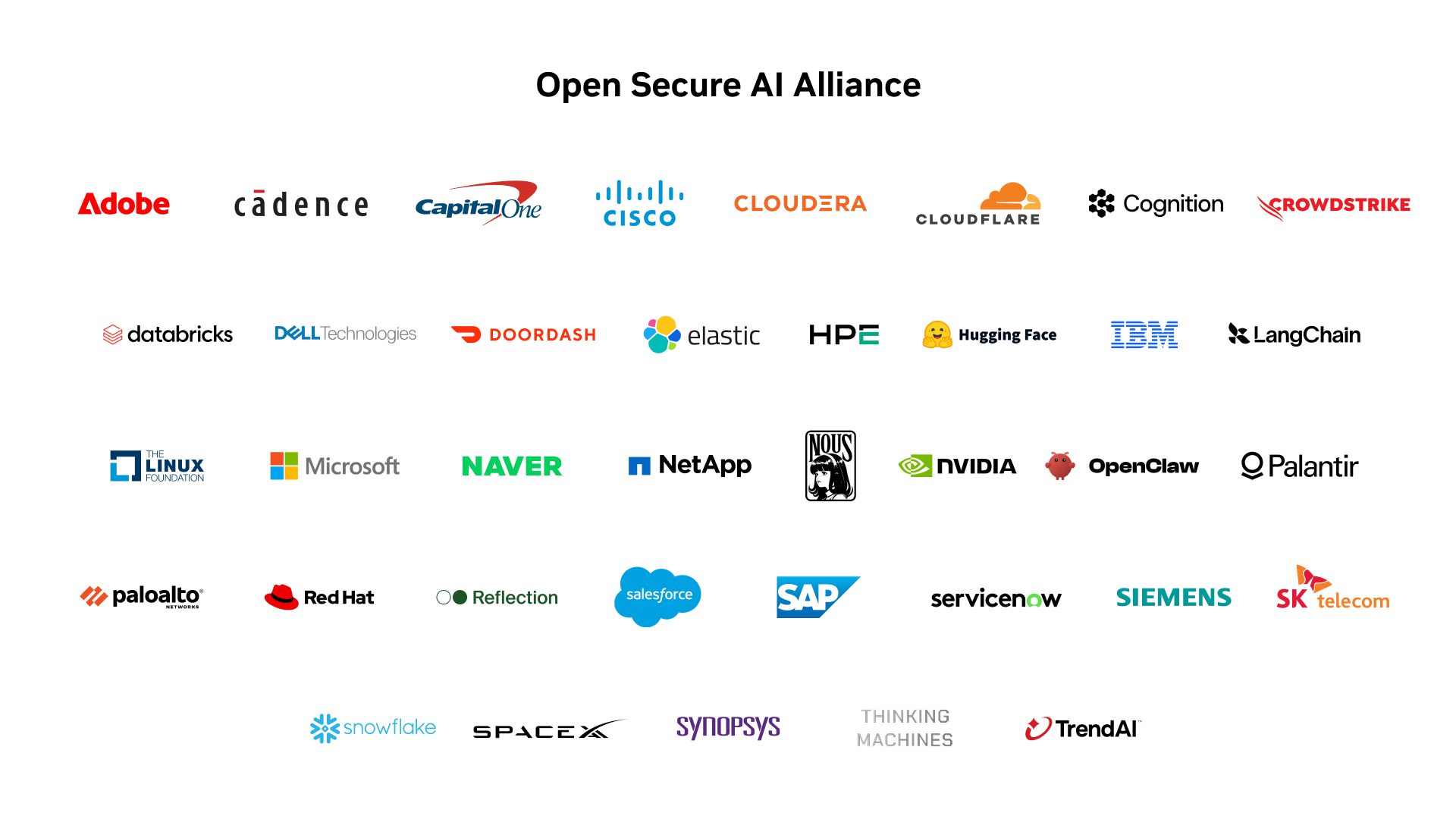
Author: Bitclever AI Research ## Executive Summary A group of technology industry leaders, including NVIDIA, announced the creation of the Open Secure AI Alliance, an initiative aimed at strengthening Artificial Intelligence security through open, transparent and auditable models. The alliance builds on the existing work of the Linux Foundation (Akrites initiative) and the OpenSSF community, positioning itself as a direct response to the limitations revealed by closed AI systems in real-world cyber defense scenarios. ## What Happened The Open Secure AI Alliance was announced as a coalition of industry leaders dedicated to vulnerability remediation and responsible disclosure through open technologies. The initiative does not stand alone: it explicitly builds on the work of the Linux Foundation, through its Akrites project — launched to defend critical open source software against AI-powered cyber threats — and on the ongoing work of OpenSSF (Open Source Security Foundation), a leading organization in defining security practices for open source ecosystems. According to the announcement, open source software is today a critical pillar of the global economy, underpinning cloud computing infrastructure, financial services, manufacturing, telecommunications, public administration and internet services. Cybersecurity is identified as one of the three sectors that benefits most from this open model, precisely because transparency and accessibility allow entire communities of experts to analyze, test and strengthen systems. A recent episode serves as a practical example of the risks the alliance intends to address: a security incident at Hugging Face, in which closed AI tools — unable to distinguish attackers from defenders — blocked essential forensic analysis during incident response. Faced with this obstacle, Hugging Face turned to the open-weight GLM 5.2 model, run on its own infrastructure, to conduct the investigation. The episode is cited as proof that cyber defenders need agentic, open, frontier AI systems to ensure self-defense capability in critical situations. ## Why This Matters The debate around open versus closed AI models has been intensifying, but this announcement brings a specific and pragmatic argument: in the field of cybersecurity, the choice between opaque and open systems has direct implications for incident response capability. The alliance's promoters argue that the world needs both closed and open models, but stress that, for cyber defense specifically, open models and harnesses offer structural advantages: they democratize defensive capabilities, increase transparency for those defending systems, enable cyber defense without compromising data protection, and complement closed frontier models with localized, customizable controls. One of the central arguments is the absence of a single point of failure. A distributed defense ecosystem, controlled by the community itself, is inherently more resilient than an architecture dependent on a small number of vendors and closed systems. At the same time, the announcement acknowledges that open models, like any powerful technology, can be subject to misuse — including attempts to weaken safeguards or repurpose capabilities for attacks. However, it emphasizes that these risks are not exclusive to open systems and must be managed wherever advanced AI is deployed. The Hugging Face incident concretely illustrates this tension: closed systems, designed without distinguishing between offensive and defensive intent, can paradoxically prevent defenders themselves from acting in critical moments. ## Business Impact For organizations managing critical infrastructure, financial systems or cloud-dependent operations, this movement carries relevant practical implications: - **Reassessing AI security strategies**: Companies that rely exclusively on closed AI tools for threat detection and response should consider integrating open, auditable solutions as a complementary layer of resilience. - **Greater scrutiny of vendors**: The ability to audit and adapt security models becomes a relevant criterion when selecting technology partners, especially in regulated sectors such as banking, healthcare and public administration. - **More collaborative vulnerability management**: Participation in initiatives such as Akrites and OpenSSF may become an indicator of security maturity, with benefits for due diligence processes, audits and regulatory compliance. - **Preparing for incident response scenarios**: The Hugging Face case demonstrates that relying solely on closed systems can create operational bottlenecks at critical moments. Security teams should consider contingency plans that include open tools. - **Cost efficiency opportunities**: Open models, when run on proprietary infrastructure, can reduce dependence on external vendors and offer greater control over operational costs at scale. ## Bitclever Perspective At Bitclever, we closely follow the evolution of this debate between open and closed AI, especially in the context of enterprise cybersecurity. Our experience in automation, systems integration and deployment of AI solutions in corporate environments allows us to help organizations navigate this transition with pragmatism. We believe the decision between open and closed models should not be ideological, but rather based on a careful assessment of each organization's operational context: system criticality, regulatory requirements, internal audit capacity, and the maturity of security teams. Initiatives such as the Open Secure AI Alliance reinforce the importance of hybrid architectures, where open and closed tools coexist in a complementary way. We support our clients in evaluating AI solutions for detection and incident response, in defining resilient security architectures, and in integrating governance practices aligned with emerging industry standards, such as those promoted by the Linux Foundation and OpenSSF. Our role is not to impose a specific technology, but to help companies build informed security strategies, tailored to their reality and prepared for crisis scenarios. ## Conclusion The creation of the Open Secure AI Alliance marks a significant moment in the debate over the future of cybersecurity in the age of AI. The Hugging Face incident concretely demonstrates that the transparency and adaptability of open models can be decisive in critical moments of threat response. For companies, the challenge lies in balancing the robustness of closed systems with the distributed resilience of open models, building security strategies that do not depend on a single point of failure. As these initiatives gain scale, organizations that invest early in understanding and adopting these approaches will be better positioned to face tomorrow's cyber threats.