seoPublished on July 16, 20266 min read

4 Types of Content Decay: How to Diagnose and Fix Organic Traffic Loss in 2026

Not every traffic drop can be fixed with a content refresh. Discover the 4 types of content decay and why AI Overviews have changed the rules of the SEO game.

SEOContent DecayAI OverviewsMarketing DigitalSearch Engine OptimizationEstratégia de ConteúdoGEO
4 Types of Content Decay: How to Diagnose and Fix Organic Traffic Loss in 2026
Bitclever AI Research
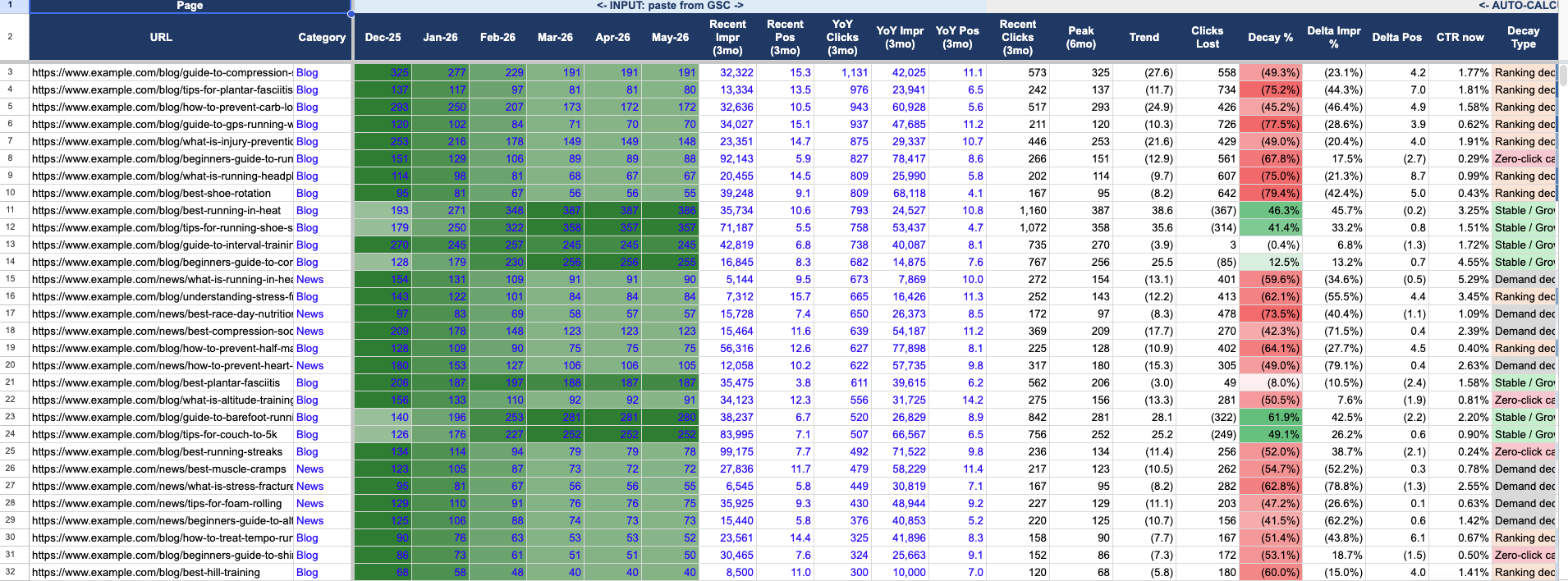
Author: Bitclever AI Research ## Executive Summary Organic traffic loss — the so-called "content decay" — used to have just three classic causes (competition, search intent shift, and declining demand). In 2026, AI Overviews have become a fourth critical factor, drastically reducing clicks even when rankings remain stable. Correctly diagnosing the type of decay before applying any fix has become essential to avoid wasting resources on updates that don't solve the real problem. ## What Happened A recent article from Search Engine Land challenged the traditional approach to content decay — the widespread practice of "updating the date, adding a few hundred words, and republishing" whenever a page loses traffic. According to the article, this knee-jerk response sometimes works, often does nothing, and occasionally even worsens the page's performance. The reason is simple: the drop in clicks is just a symptom. A page can lose traffic for at least four distinct reasons, and each requires a different fix. The traditional SEO model explained content decay through three causes: a competitor improved their content, search intent shifted, or demand for the topic declined. This model is still valid, but it's incomplete — it was created before AI Overviews became widespread on Google. The data behind this shift is revealing. In 2026, fewer than one in three Google searches drives clicks to the open web. About 68% of searches end without any click at all, up from roughly 60% just two years ago. Even more significant: in queries where an AI Overview appears, the top-ranking organic result loses about 58% of its clicks, even while maintaining the same ranking position. This phenomenon means a page can be losing traffic not because it got worse, but because the search ecosystem itself has changed how it distributes clicks. ## Why This Matters For digital marketing and SEO teams, this distinction isn't merely academic — it has direct implications for productivity and resource allocation. Applying the same "remedy" (content refresh) to problems of different natures is one of the most common causes of wasted effort in content strategies. If a page loses traffic because a competitor produced superior content, the solution involves substantially improving the quality, depth, or authority of the existing content. If the loss results from a shift in users' search intent, it may be necessary to completely rework the format or angle of the content, not just add more text. If demand for the topic has genuinely declined, perhaps the right strategy is to redirect efforts toward emerging topics rather than persisting with a subject in structural decline. But when the cause is the presence of an AI Overview that absorbs the answer before the user reaches organic results, none of these traditional tactics solve the problem. The page may be technically optimized, well-ranked, and have quality content — and still lose more than half of its potential traffic, because the answer has already been delivered directly on the results page. This is a structural turning point for the SEO discipline: the metric of success can no longer be just ranking position, but rather the actual ability to generate clicks and qualified visits. ## Business Impact For Portuguese companies that rely on organic traffic as an acquisition channel — whether in e-commerce, B2B lead generation, or editorial content — the practical implications include: **Reassessing SEO KPIs.** Traditional metrics like average position or impressions no longer tell the full story. It's necessary to cross-reference Search Console data with actual click-through rates by query type, identifying which pages are exposed to AI Overviews. **Need for diagnosis before action.** Teams that apply generic refreshes without identifying the root cause risk investing time and budget in fixes that have no impact, or that even harm the page's performance (for example, by diluting topical relevance with unnecessary additional content). **Diversification of acquisition channels.** With fewer than a third of searches generating clicks to the open web, companies that rely exclusively on organic SEO face growing concentration risk. Balancing the strategy with other channels becomes a priority — direct content marketing, email marketing, social media, and, increasingly, optimization for presence in AI-generated answers (GEO — Generative Engine Optimization). **Prioritizing content with value beyond quick answers.** Pages that merely answer simple factual questions are the most vulnerable to AI Overviews. Content that offers analysis, expert opinion, proprietary data, or hands-on experience tends to retain more value even when AI summarizes the basic answer. ## Bitclever Perspective At Bitclever, we closely track the evolution of the search landscape and the growing impact of generative AI on our clients' digital channels. The distinction between different types of content decay is precisely the kind of analysis we integrate into our SEO audit and content strategy processes. Our approach always starts with data-driven diagnosis: we analyze Search Console, SERP analysis tools, and user behavior to identify whether a traffic drop results from competitive pressure, an intent shift, genuine demand decline, or exposure to AI Overviews. This clarity prevents investments in fixes that are misaligned with the real problem. For companies facing this new landscape, we help rethink content strategies with a focus on depth and differentiation — the elements that continue to generate value even when AI absorbs part of the simple answers. We also support the diversification of digital acquisition channels, integrating traditional SEO with marketing automation, Low-Code lead generation, and emerging strategies for optimization for generative engines. Rather than reacting to traffic drops with generic solutions, we believe the right path involves deeply understanding the available data and building strategies resilient to a constantly evolving search ecosystem. ## Conclusion Content decay in 2026 can no longer be treated as a single problem with a universal solution. AI Overviews have added a fourth structural cause to organic traffic loss, requiring digital marketing teams to adopt a more analytical and less reflexive approach to performance drops. Companies that invest in rigorous diagnosis — distinguishing between competition, intent shift, demand decline, and AI absorption — will be better positioned to allocate resources effectively and build content strategies that are truly resilient to the new search landscape.